AI Content Engine:
Create 10x More Content with Same Effort 📱⚙️
Organic visibility has entered the hyper-production era. Discover how top creators and enterprise marketing brands leverage automated pipelines to create, package, and distribute dynamic multi-format assets.
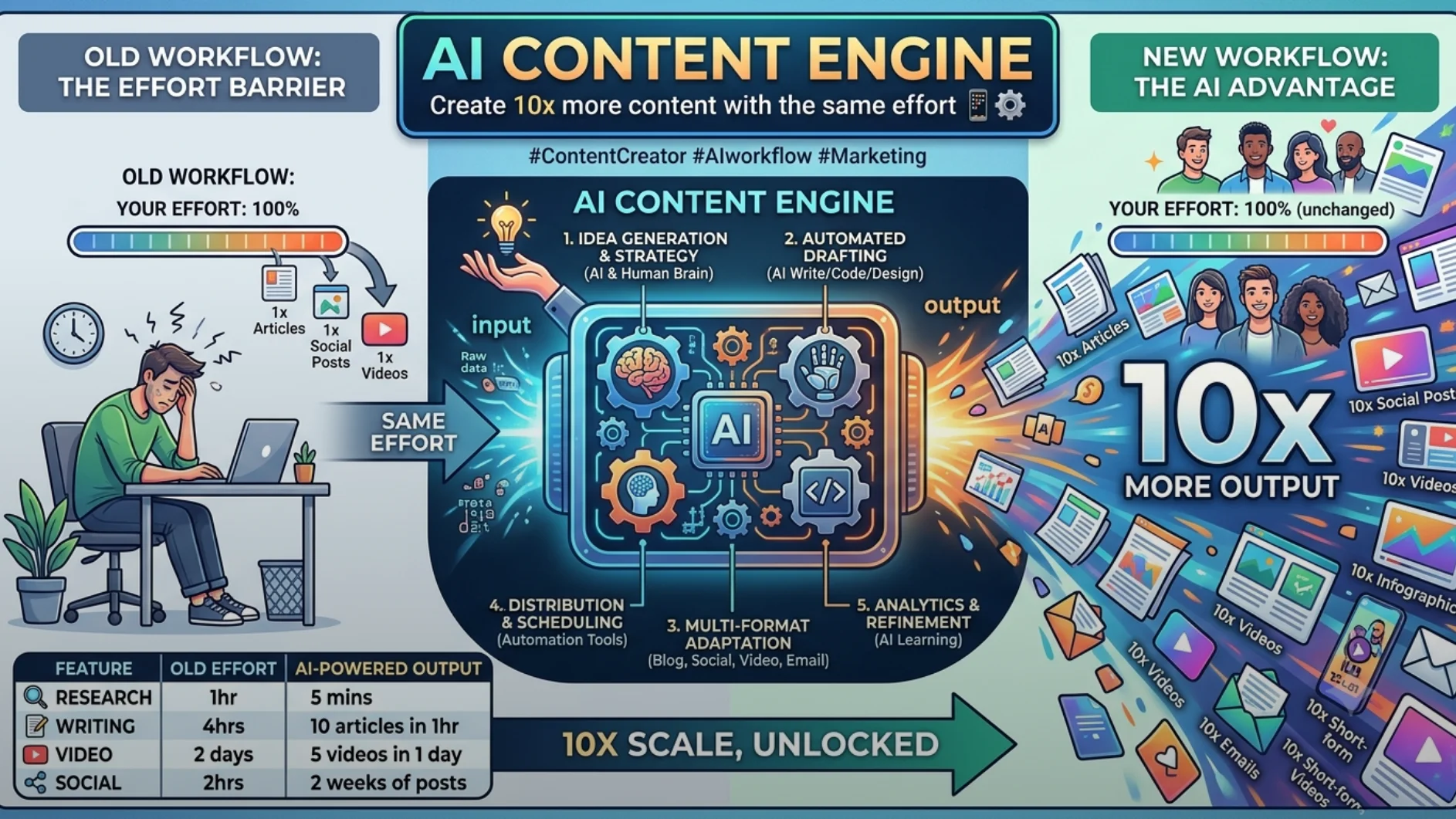
01. The Modern Content Engine Conundrum
In the highly competitive organic marketplace of 2026, content is no longer just a brand luxury—it is the digital oxygen of your business. However, standard manual models of research, outlining, scripting, editing, and scheduling are breaking down. Creators and agencies relying entirely on human labor face severe burnout and scaling limitations, as explored in the operational baseline of the "AI vs Human Workflow" metrics.
The secret of scaling output by 10x does not involve forcing creators to write faster or sleep less. Instead, it requires turning from a manual "artisan" creator to a systemic "architect" of an automated AI Content Engine. By taking the framework of the foundational "AI Productivity Stack.jpg", we can systematically separate our creative workflow into modular levels of automated execution.
The Manual Bottleneck
- Linear research that takes hours of browsing.
- Manually translating written copy into multi-platform visual scripts.
- Staring at blank pages waiting for creative angles.
The AI Engine Approach
- AI semantic research summaries from massive data layers in seconds.
- Modular asset repurposing across multiple social channels automatically.
- Predictive content calendars based on audience performance trends.
02. Deconstructing the 10x Content Engine
A functional engine is not simply a single prompt page. It is an end-to-end framework matching your target business themes to optimized AI modules. Let's look at the three primary phases of building your automated content system:
Centralized Context Integration
Most AI content falls flat because it lacks a deep brand context. By deploying Level 1 of the AI Productivity Stack.jpg (Centralized Context), you feed your brand tone, industry background, target client personas, and previous high-performing structures directly into the model base. This prevents generic outputs and builds highly customized, on-brand drafts every single cycle.
Omnichannel Asset Packaging
Once you have established secure, rich context, you transition into content creation. This maps to Level 3 of our stack, converting a single detailed root resource (such as a whitepaper, raw podcast audio, or industry analysis) into secondary platform assets like Twitter/X threads, LinkedIn carousels, and short video scripts instantly.
Autonomous Social Scheduling & Analytics
Writing high-quality drafts is useless if they stay locked in document folders. By deploying automated webhooks (Level 4 Process Optimization), your generated copy routes directly to scheduling platforms, tags appropriate accounts, and auto-schedules distribution slots based on historical reader engagement trends (Level 5 Performance & Analytics).
03. Driving Inbound Revenue with Automated Scaling
Scaling your content engine is not just about gaining attention—it is about securing high-value, predictable income. By establishing structured, multi-channel production workflows, you position yourself as a market leader. This maps directly to the lucrative services outlined in our roadmap for "AI Side Hustles 2026", where agencies command monthly retainers of $2,000+ to build automated content assets for clients.
Rather than building every asset manually, your primary role transitions from an active copywriter into an orchestration architect. You build context models, review the output pipelines, and let the model clusters execute the heavy writing, formatting, and scaling work autonomously.
Download Your AI Content Blueprint
Claim our step-by-step model prompt guide, automated webhook layouts, and multi-platform content scheduling matrices.