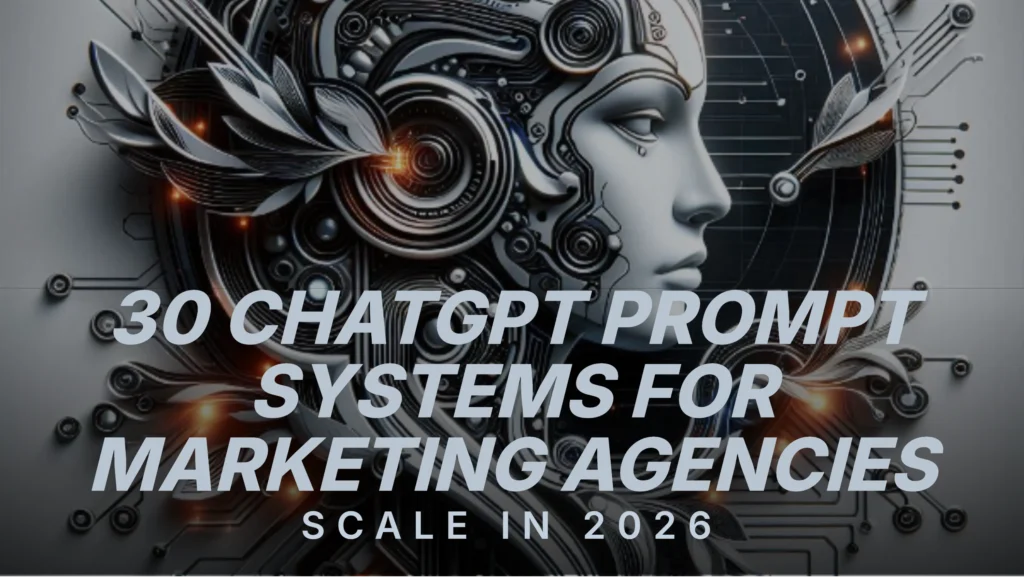
30 ChatGPT Prompt Systems for Marketing Agencies
For marketing agencies in 2026; efficiency is the only way to maintain healthy margins. Using a ChatGPT content workflow is no longer just about writing faster; it is about building systematized prompt libraries that deliver consistent; high-quality results across diverse client portfolios. These 30 prompt systems allow your team to move from manual execution to AI-assisted strategy; ensuring that your agency remains competitive in an increasingly automated landscape.
The Power of Systematized” Prompting
Most beginners use one-off questions; but professional agencies use prompt systems. A system is a multi-step framework that provides the AI with a persona; specific context; and structural constraints. This prevents the “AI fluff” often found in generic outputs and ensures that every deliverable—from SEO audits to social media calendars—matches your agency’s high standards. By building a internal library of these systems; you enable even junior staff to produce senior-level work.
- Strategic Systems: Build SWOT analyses; buyer personas; and competitive messaging maps in seconds.
- Creative Systems: Generate campaign territories; high-fidelity visual prompts; and vertical video scripts.
- Technical Systems: Automate meta-tag generation; schema markup; and technical SEO audit summaries.
- Operational Systems: Draft stakeholder updates; meeting agendas; and project delay communications.
Advanced Frameworks for Client Deliverables
In 2026; ChatGPT prompts for agencies focus heavily on Chain-of-Thought (CoT) reasoning. Instead of asking for a finished product; you prompt the AI to first “think” through the logic. For example; when creating a brand voice guide; ask the AI to first analyze three competitor voices; identify the gaps; and then propose a unique tone for your client. This iterative process ensures that the final output is backed by strategic reasoning; making it much easier to sell to stakeholders.
Implementing an Agency-Wide Prompt Library
To scale these systems; you must move them out of individual chat histories and into a shared Prompt Library. Tools like Notion; Airtable; or dedicated AI management platforms allow your team to tag prompts by department (e.g.; #PaidMedia; #SEO; #Copywriting). Each entry should include a variable list—placeholders like [Client Industry] or [Target KPI]—that allow account managers to customize the system for any new account in seconds. This standardization reduces the “prompt lottery” and ensures predictable quality across the board.
Ethics; Governance; and Human Oversight
As your agency adopts more ChatGPT prompts for agencies; governance becomes critical. Your systems should include “Fairness Checks” and compliance reviews; especially for clients in regulated industries like finance or healthcare. In 2026; the most successful agencies are those that use AI for 80% of the heavy lifting but retain the final 20% for human expertise. Your prompts should always end with a request for the AI to “suggest potential risks or weaknesses” in its own output; forcing a layer of critical analysis before any draft reaches a client.
Conclusion
Transitioning to a prompt-based workflow is the most significant upgrade a marketing agency can make in 2026. These 30 systems provide the blueprint for a faster; smarter; and more profitable business model. By treating AI as a collaborative partner rather than a replacement; your team can focus on the creative strategy that truly moves the needle for your clients. Start by implementing just three of these systems this week and witness the immediate impact on your agency’s productivity.
“