
Artemis II: Pioneering the Next Era of Lunar Exploration
The Artemis II mission represents a monumental leap for NASA and international space exploration. Launched on April 1; 2026; from the Kennedy Space Center; this mission carries a crew of four astronauts on a 10-day journey around the Moon. This flight is the first crewed mission to travel beyond low Earth orbit since the Apollo 17 mission in 1972; signaling a new chapter in the Artemis program.
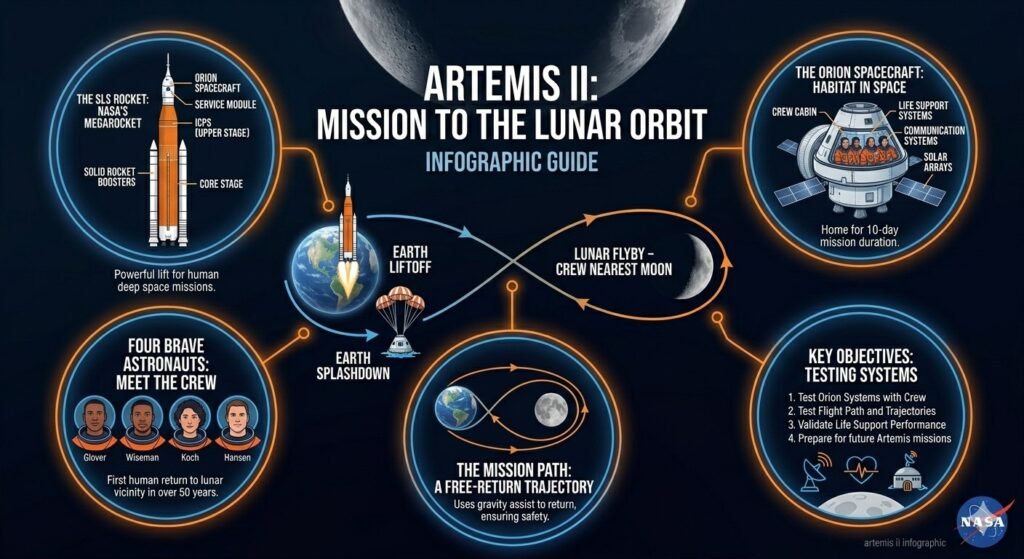
The Historic Crew of Artemis II
The crew consists of four trailblazing individuals who represent the diversity and technical excellence of modern spaceflight:
- Reid Wiseman (Commander): A veteran NASA astronaut leading the mission.
- Victor Glover (Pilot): The first person of color to participate in a lunar mission.
- Christina Koch (Mission Specialist): The first woman to fly to the Moon.
- Jeremy Hansen (Mission Specialist): Representing the Canadian Space Agency; he is the first non-American to venture into deep space.
Mission Objectives and the SLS Rocket
The primary goal of Artemis II is to validate the Space Launch System (SLS) rocket and the Orion spacecraft. Unlike future missions; Artemis II will not land on the lunar surface. Instead; it follows a free-return trajectory; using the Moon’s gravity to slingshot the spacecraft back toward Earth. This critical test ensures that life support systems; communication arrays; and navigation tools are fully functional for human occupants in deep space.
Technical Milestones and Flight Path
The mission profile includes several high-stakes maneuvers:
- High Earth Orbit (HEO) Operations: The crew spent the first 24 hours testing manual piloting and proximity operations.
- Translunar Injection: A powerful engine burn that propelled Orion toward the Moon.
- Lunar Flyby: The spacecraft will pass approximately 4;600 miles above the lunar surface; providing unprecedented views of the Moon’s far side.
- Pacific Ocean Splashdown: The mission concludes with a high-speed re-entry into Earth’s atmosphere and a controlled landing at sea.
Why Artemis II is a Vital Step
NASA is not just visiting the Moon; it is staying. Artemis II provides the data necessary for Artemis III; which aims to land humans near the lunar South Pole. By testing these systems today; NASA ensures the safety of future explorers who will build the Lunar Gateway and eventually journey to Mars. The success of this mission confirms that humanity is ready to once again walk among the stars.