
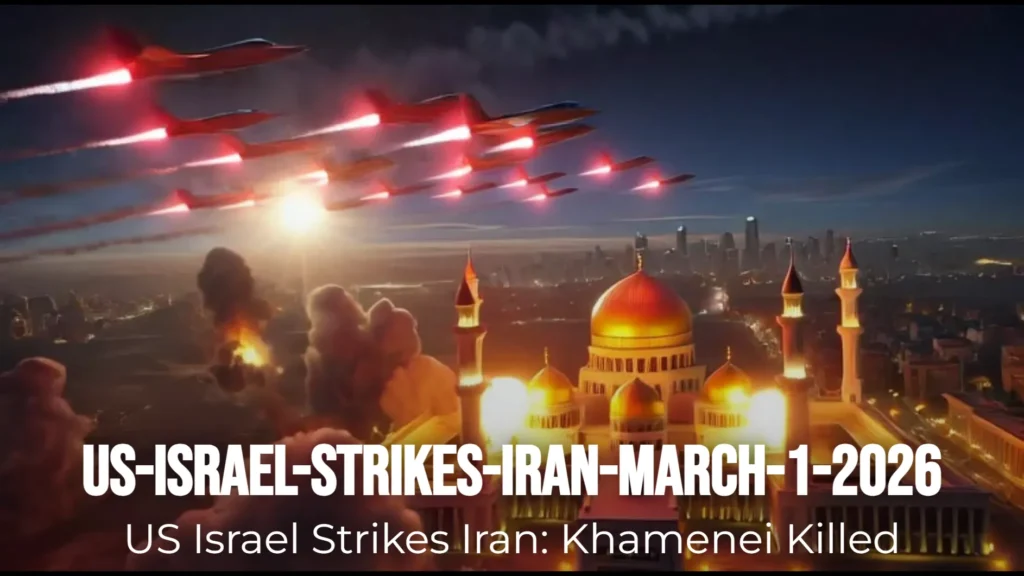
US-Israel Strikes on Iran: Supreme Leader Khamenei Killed – March 1 2026 Crisis Explained
Early Sunday March 1 2026; the United States and Israel executed coordinated airstrikes across Iran targeting leadership compounds; nuclear facilities; and military infrastructure. Iranian state media confirmed Supreme Leader Ayatollah Ali Khamenei’s death in the attacks; marking a seismic shift in Middle East geopolitics. This dramatic escalation follows months of failed nuclear negotiations; with President Donald Trump vowing to neutralize Iran’s nuclear threat and regional proxy network.
Timeline of the March 1 Attacks
Strikes began late February 28 targeting Tehran and key nuclear sites as Khamenei met his inner circle. US B-2 bombers and Israeli F-35s delivered precision munitions; destroying command centers and enrichment facilities. Iranian reports claim hundreds killed including civilians; though independent verification remains limited amid communication blackouts.
- Sources confirm Khamenei’s location during the precise window of attack
- Targets included Natanz; Fordow; and IRGC headquarters
- US describes operation as “decapitation strike” to end regime threats
Iran’s Immediate Retaliation
Iran responded with over 300 ballistic missiles and drones targeting US bases in Iraq; Syria; and Gulf states alongside Israeli cities. Early reports indicate one Israeli civilian death and damage to US facilities in Jordan. Yemen’s Houthis announced Red Sea shipping attacks resumption; threatening global trade routes.
Key retaliation targets:
- US Al Udeid base in Qatar
- Israeli air defense installations
- Gulf monarchies hosting US forces
- Energy infrastructure in Saudi Arabia; UAE
Background: Failed Nuclear Talks
These strikes terminate 2025-2026 US-Iran negotiations that concluded February 26 without agreement. Washington demanded complete nuclear dismantlement and proxy activity cessation; demands Tehran rejected. Trump administration cited Iranian violations of prior commitments and proxy attacks on US interests as justification for military action.
Global Reactions Pour In
Russia condemned the strikes as “unacceptable aggression” warning of radiological risks from nuclear site damage; offering mediation. China called for restraint while European allies urged immediate ceasefire talks. UN Security Council emergency session scheduled for March 1 afternoon.
- Moscow pledges military-technical support to Tehran
- EU leaders push for diplomatic off-ramp
- Gulf states brace for spillover effects
Economic Fallout Accelerates
Brent crude surged 15% to $110/barrel on supply disruption fears. Red Sea shipping halted as insurers withdraw coverage. Global markets opened sharply lower with defense stocks soaring.
What Happens Next?
Succession crisis grips Iran as Revolutionary Guard commanders assume emergency control. US maintains heightened Middle East force posture warning against further escalation. Intelligence sources predict Iranian proxy activation across region within 72 hours.
Regional war appears imminent unless rapid de-escalation occurs. World watches anxiously as nuclear-armed Israel faces retaliation from world’s leading state sponsor of terrorism now operating without central command.
Historical Context
This confrontation caps decades of shadow war between Iran; Israel; and United States. Previous flashpoints include 2020 Soleimani assassination; 2024 direct Israel-Iran exchanges; and ongoing proxy battles. Sunday’s strikes represent most direct great-power intervention in Iranian territory since 1979.
Strategic Implications
US achieves short-term objectives destroying key nuclear infrastructure and leadership continuity. Long-term Iranian retaliation capacity remains substantial through asymmetric proxies. Regional Shia militias now operate without Tehran’s coordinating hand; potentially increasing unpredictability.
Israel gains breathing space from missile threat but faces unprecedented direct attacks on homeland. Sunni Gulf states quietly celebrate regime weakening despite public neutrality statements.
Domestic US Political Ramifications
President Trump’s reelection platform emphasized Iran confrontation. Sunday strikes validate hardline approach though critics warn of entanglement risks. Congressional leadership briefed; bipartisan support appears solid initially.
Energy Markets Under Pressure
Straight of Hormuz remains open but insurance costs prohibitive. Saudi Arabia pledges spare capacity though infrastructure remains vulnerable. Global recession fears mount as inflation rebounds.
Humanitarian Concerns Mount
Iranian civilian casualties likely exceed 500 with nuclear site strikes raising radiological exposure questions. Internet blackout prevents accurate reporting. International aid organizations denied access.
Global Security Realignment
Russia-Iran strategic partnership deepens challenging US Middle East dominance. China watches warily as Belt and Road investments threatened. NATO southern flank activation discussions begin.
This represents most dangerous Middle East crisis since 1973 Arab-Israeli war. Resolution appears distant as grief-stricken Iran contemplates response while victory-flushed Washington; Jerusalem contemplate next moves.
