
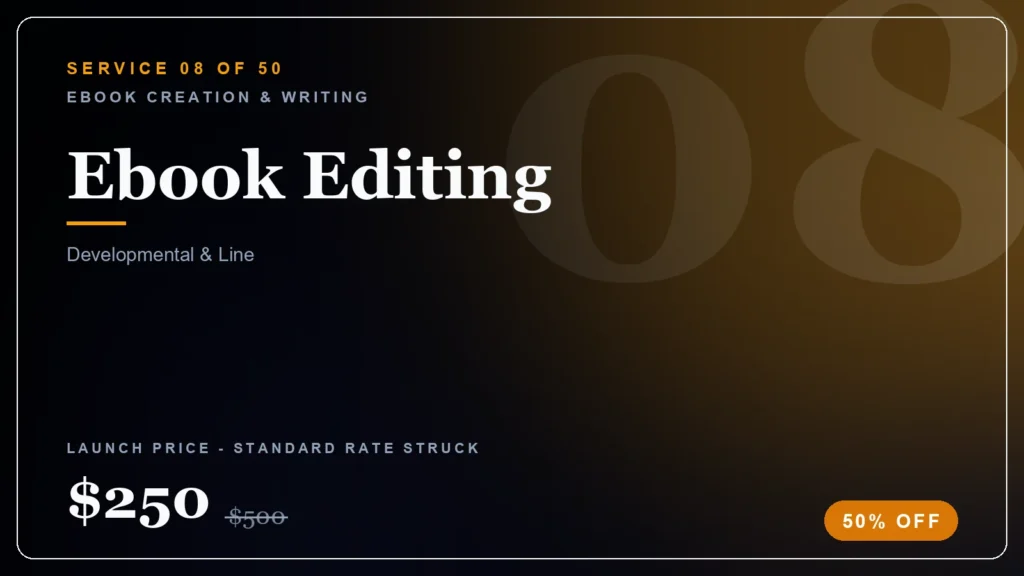
Editing is not proofreading with a bigger invoice. A developmental edit asks whether the book works — whether the argument holds, the middle sags, the character earns the ending. A line edit asks whether every sentence is doing its job. Most manuscripts need both, in that order, and most authors skip the first one because it is harder to accept.
Two levels of editing, one price
- Developmental edit: a written report on structure, pacing, chapter order, argument, character arcs and the reader’s likely questions, with a chapter-by-chapter breakdown.
- Line edit: sentence-level work — clarity, rhythm, repetition, tense, point of view, and the places where the meaning is not quite what you intended.
- Consistency pass: names, dates, numbers, capitalisation, British or American spelling, and the terminology you defined in chapter two and contradicted in chapter nine.
- Tracked changes: every edit visible and reversible, with comments explaining the ones that are judgement calls.
- A clean final file plus the report, so you can apply the lessons to the next book.
How the edit runs
- Sample edit. Send 1,500 words and you get a free sample of the markup plus a realistic quote, so there are no surprises about depth.
- Developmental read. The full manuscript read once for structure; you receive the report before any line work begins.
- Author response. You accept, reject or discuss the structural notes. Nothing is rewritten behind your back.
- Line edit and return. The sentence-level pass on the agreed version, with tracked changes and a summary of recurring habits.
What we edit
Fiction and non-fiction up to 18,000 words per book: novels and novellas, memoirs, business and self-help titles, technical guides, and translated manuscripts that need an English ear. We do not rewrite the book for you at this price — that is a ghostwriting conversation — but we will tell you where rewriting is genuinely needed rather than polishing prose that should be cut.
Who this is for
Indie authors before upload, because a one-star review about typos costs more than the edit. Business authors whose manuscript has been read by colleagues but never by an editor. Translators who need a native pass. Anyone who has been too close to the text for too long to see it any more.
What we look for first
The first read is not about sentences. It is about whether the book delivers what the first page promises, whether the middle earns its length, and whether the ending resolves the question the reader was actually holding. We mark the point where attention drops and say plainly why — a repeated idea, a chapter that restates the previous one, a character who stops wanting anything.
Only once that is settled do we work at line level, which is also why the report arrives before the markup: rewriting prose inside a structure that needs moving is expensive work done twice.
Pricing
| Tier | Scope | Price | Was | You save |
|---|---|---|---|---|
| Starter | 1 ebook — up to 18,000 words | $120 | $130 | |
| Professional | 3 ebooks | $330 | $345 | |
| Bulk / Authority | 5 ebooks | $500 | $500 |
Frequent questions
Do I need editing before proofreading?
Yes. Proofreading fixes surface errors on a finished text; editing changes the text. Doing them in the wrong order means paying twice for the same pages.
How long does it take?
Seven to ten working days for an 18,000-word manuscript, longer for bulk orders. Rush slots are available for a stated surcharge.
Will you change my voice?
No. Line editing removes what gets in the way of your voice — clutter, repetition, hedging — and leaves the sound of you intact.
Send a sample for a free edit — 1,500 words is enough for a quote and a sense of how we work.